Sunday, July 31, 2016

#31 Aladdin


Coming off the towering artistic achievement of Beauty and the Beast, Aladdin took the Disney Renaissance into the realm of Arabian Nights, marrying lavish Middle Eastern aesthetics to a story filled with adventure, magic, romance, and a surprising amount more direct humor than most of Disney's fantasy pieces.

Aladdin is a serviceable hero, though a rather bland one: his only real motivation and struggle involves how to end up with Jasmine. Jasmine herself is a bit more compelling: she's trapped by a sheltered existence in a society that demands that she play the role of a princess and get married, when she desires a more meaningful life (and of course we get the typical love-at-first-sight Disney romance we've seen over and over by this point). Jafar manages to earn himself a place in the pantheon of Disney villains through his power-hungry plotting and sleazy demeanor (courtesy of voice actor Jonathan Freeman), while his power-escalation during the climax lends it quite an epic feel. The Sultan, on the other hand, is a completely ineffectual doddering fool, effortlessly dominated by Jafar and harping on about a marriage law that, as a monarch, he surely has the power to get rid of (which he does at the end, making one wonder why he didn't do so in the first place).

The true standout of the film though, is, of course, Robin Williams as the Genie. Prior to his entrance, the film is a straightforward Arabian adventure film revolving around a romance; once he appears, he immediately steals the entire film, firing off sight-gags, pop-culture jokes and references to other Disney films with riveting abandon. The filmmakers gave Williams free reign to ad-lib during the recording sessions, with the animators translating his signature brand of manic unrestraint to the screen. The result is a character that feels one hundred percent like a Robin Williams performance, one of the few times an animated character has been made to so perfectly embody the qualities of their performer, and possibly one of the greatest voice acting jobs of all time. If there's anything negative to be said about Williams as the Genie, it's that it opened the door for a long succession of animated films that cast A-list actors more for their name than for their suitability to the role (witness half of Dreamworks' animated output).

While not quite reaching the level of elegant artistry achieved by its immediate predecessor and successor, Aladdin still manages to be a film of quality, blending disparate elements of adventure, romance, and humor into a unified package that stands as a testament to the skill of the animators, the voice cast, and especially to the never-to-be-replicated talents of Robin Williams.

Wednesday, July 27, 2016

#30 Beauty and the Beast


Continuing Disney's early-Renaissance streak, Beauty and the Beast was the first animated film to be nominated for a Best Picture Academy Award, and for good reason; it's a marriage of artistic style, music, animation, and story that comes together with a fantastic sense of unity and cohesiveness as it redefines a classic fairy tale for the modern age.

In crafting the film's aesthetic, the animators delved straight into the original story's French origins, rendering both lush, picturesque countryside landscapes, and expansive Gothic architecture for the Beast's castle. The attention to detail and atmosphere in the castle is such that it almost becomes a character unto itself, especially in early scenes: the dimly lit, massive rooms feel at once vast and suffocating. As for the characters themselves, they're an excellently varied cast. Belle manages to stand out among the crowd of Disney princesses by being unashamed of being intelligent and wanting more out of life than her backwater town can provide. The Beast himself stands as a triumph of character design, combining aspects of various animals into a whole that isn't recognizable as any existing creature, but manages to embody the definition of the word "beast" with perfection, while Robby Benson's performance as a bitter, angry, childlike creature succeeds in adding complexity and humanity to what could be a generic animal-man character (he is not, as one commentator termed it, "Disney's Wolverine"). Gaston, meanwhile, emerges as a uniquely sinister villain: he's a supremely arrogant boor who believes that his masculinity entitles him to women's affections, and whose driving goal is to domesticate an independent woman - in short, he's the kind of misogynist we all know.

The animation sequences, meanwhile, are bolstered by a more liberal use of CGI to have masses of characters and objects moving in concert (witness the spectacularly choreographed "Be Our Guest"), as well as to add a new cinematic dimension to sequences like "Beauty and the Beast," with the camera free-flying throughout the ballroom. And on the subject of the music, it's another standout of the film, with Alan Menken and Howard Ashman crafting a set of songs that move the story forward, while still leaving space for showstoppers like "Be Our Guest" and "Beauty and the Beast." (Incidentally, the song "Human Again," cut from the original film and restored for the Special Edition, would be better left out; the lyrics are subpar by Menken and Ashman's standards, and the sequence as a whole is too similar to "Be Our Guest.")

Beauty and the Beast is, much like Sleeping Beauty, an absolutely beautiful film, but while Sleeping Beauty embodies storybook elegance, Beauty and the Beast delivers a more modern, diverse beauty, peppering in Gothic regality, timeless love story tropes, mystical intrigue, and moments of humor. If fairy tale films are the meat of Disney's canon, Beauty and the Beast represents their pinnacle.

Monday, February 8, 2016

#29 The Rescuers Down Under

Rescuersduposter.jpg

Numerous Disney films have gotten sequels over the years, most of them direct-to-video and almost all of them uniformly terrible. The Rescuers Down Under is the only one to be considered official Disney canon, and also the only one to be superior to its predecessor in every conceivable way. Gone is the stiff xerographic animation and musically sterile production of the original; Down Under is so relentlessly fun, adventurous and exciting that the original seems positively glacial by comparison.

While The Little Mermaid was still a bit of a transition from the post-Walt era to the Renaissance in terms of animation, Down Under is the first true display of what made Disney so great in the nineties: fluid animation, impeccable artwork, a restrained use of CGI, and cinematography that feels genuinely cinematic. The sequences of the golden eagle, Marahute, seem to exist chiefly to display the fantastic style of Disney's new order, and they succeed admirably: these sequences on their own possess more of a grand sense of exhilaration than some entire post-Walt films. Even the characters and environments returning from the first film seem entirely fresh and new, reimagined through the lens of Disney's new artistic paradigm.

And those returning characters are better than they ever were in the original film, thanks to a fantastically fun script with an emphasis on characterization. Bernard and Bianca emerge as far more active and interesting characters (partly because Down Under actually lets them do things), while their relationship actually gets some time to establish and develop. The objective of their mission, Cody, is essentially a male version of Penny, and while he's admittedly the least interesting character, he is at least proactive, evidently spending his time releasing animals caught by poachers. The villain McLeach, played with cackling relish by George C. Scott, is a far more effective antagonist than Medusa, being both more insidious (he's a poacher who gleefully sings about murdering animals) and actually having some legitimately funny scenes - plus he drives a vehicle that looks like he stole it off the set of Fury Road. Even the supporting cast are all memorable and full of charm and personality: Jake, the charismatic mouse equivalent of Crocodile Dundee; Wilbur, the albatross voiced by the always hilarious John Candy; Frank, the neurotic frill-necked lizard; Doctor Mouse, who apparently performs surgery with a chainsaw he calls the "epidermal tissue disruptor."

While The Rescuers is fairly well-known, The Rescuers Down Under remains one of Disney's least-remembered films, possibly because it was released in the middle of Disney's greatest run of films - it's immediately preceded by The Little Mermaid, and followed by Beauty and the Beast, Aladdin, and The Lion King. While it doesn't quite reach the spectacular, visionary heights of any of those films, it's still a well-written, fun adventure film in it's own right. In short, it's everything The Rescuers should have been, but even better.

Sunday, January 31, 2016

#28 The Little Mermaid


After over 20 years of post-Walt Disney hit-or-miss films, The Little Mermaid proved to be the critical turning point for Disney's entire history. It began the Disney Renaissance, the resurgence of animation talent and artistry that continued through the nineties, redefining Disney for the modern age and reestablishing it as a true cultural institution. As a film, it established many of the tropes that would define the Renaissance, and after decades of misfires like The Aristocats and Oliver and Company, it comes off as a revelation.

Undeniably both the most ambitious and beautiful Disney film since Sleeping Beauty, The Little Mermaid establishes the elegant, lifelike style of animation that would prove a hallmark of the Renaissance. The character designs and voice acting combine in a perfect marriage to produce a fantastically memorable cast; no one feels annoying or unnecessary. The true standout is Ursula, the best Disney villain since Cruella de Vil, who conveys a fantastic diva-esque menace before blossoming into grand scale, godlike evil for a climax that feels genuinely epic. The story, while still running with the Disney standbys of love at first sight, mutual love within a few days and getting married as a teenager, manages to still be compelling enough that its flaws can easily be ignored, and it carries a genuine sense of stakes and urgency, while having some fantastic moments of emotion.

And on the subject of emotion, it's helped along by one of the best soundtracks in Disney's canon (courtesy of the first collaboration between the powerhouse team of Alan Menkin and Howard Ashman, whose work would go on to define the Renaissance, and, for many people, Disney in general). Every song hits the mark; "Under the Sea" is irresistibly fun, "Poor Unfortunate Souls" is one of Disney's greatest villain songs, and "Part of Your World" is the establishing moment for both Ariel as a character and Menkin and Ashman as a team (and also just might be my favorite Disney song).

By the time it reaches its happy ending, The Little Mermaid feels like a massive payoff. It's the first film in decades to fully recapture the majesty, artistry, fun and excitement of Disney's best efforts; above all, it's a beautiful film. If a Renaissance is a rebirth, The Little Mermaid is just that, paving the way for quite possibly the greatest era of Disney's history.

Friday, January 29, 2016

#27 Oliver and Company


The Great Mouse Detective
may have been an early foreshadowing of the Disney Renaissance, but the studio's wilderness years were not over yet, as Oliver and Company conclusively proves. Like The Black Cauldron, there are points at which it barely feels like a Disney film, but while The Black Cauldron came off like a dark, cultish 80's fantasy, Oliver and Company comes off at times like an 80's animation studio attempting to make a Disney-style talking-animals film.

The biggest problem with the film is that it's painfully dated, due in large part to the soundtrack, laden with saxophones and synth-piano that embody the corniest aspects of 80's pop (the fact that Huey Lewis sings the opening song does not help matters), in addition to being generally substandard lyrically (half of them being preoccupied with exalting New York and the "rhythm of the streets" or some such faff). The animation as well is completely lacking the timeless quality of Disney's better films, feeling more like a lesser Don Bluth effort than some of Don Bluth's own films (it might be telling that The Land Before Time opened against Oliver and Company at the box office, and roundly defeated it in its opening weekend). 

The characters don't fare much better either; Billy Joel's take on Dodger is thoroughly irritating, both for the blandness of the character and Joel's insufferable affected New York accent. Cheech Marin plays Tito the chihuahua basically as himself as a dog, while Bette Midler's Georgette, while capturing Midler's diva persona well, could probably be dispensed with completely without really affecting the plot. Jenny, the utterly generic rich girl with absent parents, is functionally an export of Penny from The Rescuers, although with far less personality and some odd animation problems; her head frequently appears too big for her body, and her facial features seem to drift at points. The villain, Sykes, meanwhile, almost seems like he belongs in a far darker film, at various points discussing the proper way to perform a hit over the phone and threatening a young girl with his vicious dogs, before getting killed by a train. As for Oliver himself, he's a protagonist entirely without agency, ping-ponging between situations through factors entirely apart from his control, existing only to be irksomely precious on a borderline-Aristocats level.

Oliver and Company is a film in which very little works, coming at the tail end of a long period of Disney's history in which many things were tried, with some successes and many misfires. A new era was about to begin, however, which would restore Disney to its Silver Age greatness, and, in many ways, exceed it. The Disney Renaissance was about to begin.

Monday, January 18, 2016

#26 The Great Mouse Detective

Mousedetectposter.jpg

Undeniably a more classically Disneyish film than The Black Cauldron, The Great Mouse Detective is one of Disney's most underrated successes. It's imaginative, adventurous, and brilliantly written and acted, giving us an underground animal society of London that allows the film to focus on its anthropomorphic cast without worrying about humans (with the exception of a cameo by Holmes and Watson themselves). Quite honestly, it's everything The Rescuers could have been, but better.

The best aspect of the film is doubtless the hero/villain pairing of Basil of Baker Street and Professor Ratigan, whose rivalry captures the classic nemesis relationship in a manner unique in Disney's canon. Basil, voiced by Barrie Ingham and based on the archetype of Sherlock Holmes, is delightfully eccentric, swinging between barely contained mania and suave intelligence. His Moriarty, Professor Ratigan, is voiced by Vincent Price, clearly enjoying himself greatly in a flamboyant performance that makes his interactions with Basil almost homoerotic. The flamboyance of Price's performance makes the climax, with Ratigan devolving into violent, animalistic fury, just that much more effective.

The film is also an artistic triumph for Disney's animators. The exploration and chase sequences in a toy shop (artistically reminiscent of Geppetto's workshop in Pinocchio) showcase a creative energy sorely lacking in the post-Walt era. The character designs are all charming and original, while the animation quality approaches that of the Disney Renaissance (though it's a bit hard to find justification for a barroom cabaret sequence that gets almost inappropriately risque). One of the most notable elements, however, is the sequence inside of Big Ben, which employed early CGI to generate a three-dimensional environment of massive moving gears to spectacular effect. More accessible than The Black Cauldron, more energetic than The Rescuers, and possessing a creative spirit not seen in a Disney film for years beforehand, The Great Mouse Detective earns its place as one of Disney's most fun adventures.

Saturday, January 16, 2016

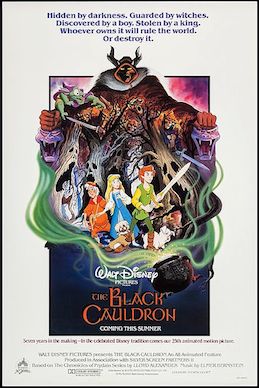
#25 The Black Cauldron

The Black Cauldron poster.jpg

It's actually quite easy, while watching The Black Cauldron, Disney's adaptation of Lloyd Alexander's The Chronicles of Prydain, to forget that it's a Disney film at all. Thematically and visually, it has more in common with Ralph Bakshi's animated fantasy films (though still considerably lighter) than with any of the rest of Disney's canon. Perhaps because of its uniqueness as Disney's only foray into high-fantasy, coupled with its extremely dark content, the film has always been a black sheep for Disney, while at the same time being a beloved cult hit.

The Black Cauldron is quite definitely a fantasy film first, a Disney film second. The environments and character design all reflect the influence of the Celtic fantasy style Alexander originally drew inspiration from. The story and characters all embody a fairly standard set of fantasy tropes: we have the ancient, evil artifact that bestows horrifying power (the cauldron), the teenage boy who wants to be a hero, the princess (Eilonwy, who swings between being proactive and a distressed damsel as if the writers couldn't exactly decide where they wanted to take her character), the odd creature sidekick (Gurgi, whose character basically amounts to "hairy Smeagol"), and the evil lord, the Horned King (voiced by John Hurt, who rarely, if ever, gives a bad performance, this being no exception). Oh, and a pig that sees psychic visions. No, it doesn't particularly make sense in context either.

Yet, despite its adherence to formula, The Black Cauldron can actually be quite enjoyable when viewed on its own terms (even if its appeal is decidedly cult). Seeing Disney take on a high-fantasy epic is definitely interesting, and while the animation is uneven and frequently less-than-spectacular, the film makes up for it with bold, cinematic angles and camera movement. While too dark to appeal to the family audience of most Disney films, it definitely shows that Disney can accomplish quite a bit with more mature, genre-oriented material. The Black Cauldron is definitely a hidden gem in Disney's canon, and one with definite potential to be revisited in live-action; in the hands of a director like Guillermo del Toro, it could be magic waiting to happen.