Monday, January 18, 2016

#26 The Great Mouse Detective

Mousedetectposter.jpg

Undeniably a more classically Disneyish film than The Black Cauldron, The Great Mouse Detective is one of Disney's most underrated successes. It's imaginative, adventurous, and brilliantly written and acted, giving us an underground animal society of London that allows the film to focus on its anthropomorphic cast without worrying about humans (with the exception of a cameo by Holmes and Watson themselves). Quite honestly, it's everything The Rescuers could have been, but better.

The best aspect of the film is doubtless the hero/villain pairing of Basil of Baker Street and Professor Ratigan, whose rivalry captures the classic nemesis relationship in a manner unique in Disney's canon. Basil, voiced by Barrie Ingham and based on the archetype of Sherlock Holmes, is delightfully eccentric, swinging between barely contained mania and suave intelligence. His Moriarty, Professor Ratigan, is voiced by Vincent Price, clearly enjoying himself greatly in a flamboyant performance that makes his interactions with Basil almost homoerotic. The flamboyance of Price's performance makes the climax, with Ratigan devolving into violent, animalistic fury, just that much more effective.

The film is also an artistic triumph for Disney's animators. The exploration and chase sequences in a toy shop (artistically reminiscent of Geppetto's workshop in Pinocchio) showcase a creative energy sorely lacking in the post-Walt era. The character designs are all charming and original, while the animation quality approaches that of the Disney Renaissance (though it's a bit hard to find justification for a barroom cabaret sequence that gets almost inappropriately risque). One of the most notable elements, however, is the sequence inside of Big Ben, which employed early CGI to generate a three-dimensional environment of massive moving gears to spectacular effect. More accessible than The Black Cauldron, more energetic than The Rescuers, and possessing a creative spirit not seen in a Disney film for years beforehand, The Great Mouse Detective earns its place as one of Disney's most fun adventures.

Saturday, January 16, 2016

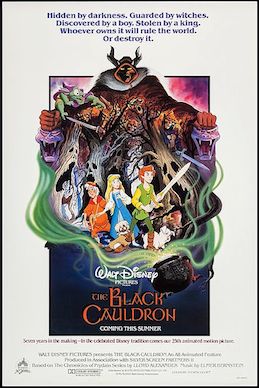
#25 The Black Cauldron

The Black Cauldron poster.jpg

It's actually quite easy, while watching The Black Cauldron, Disney's adaptation of Lloyd Alexander's The Chronicles of Prydain, to forget that it's a Disney film at all. Thematically and visually, it has more in common with Ralph Bakshi's animated fantasy films (though still considerably lighter) than with any of the rest of Disney's canon. Perhaps because of its uniqueness as Disney's only foray into high-fantasy, coupled with its extremely dark content, the film has always been a black sheep for Disney, while at the same time being a beloved cult hit.

The Black Cauldron is quite definitely a fantasy film first, a Disney film second. The environments and character design all reflect the influence of the Celtic fantasy style Alexander originally drew inspiration from. The story and characters all embody a fairly standard set of fantasy tropes: we have the ancient, evil artifact that bestows horrifying power (the cauldron), the teenage boy who wants to be a hero, the princess (Eilonwy, who swings between being proactive and a distressed damsel as if the writers couldn't exactly decide where they wanted to take her character), the odd creature sidekick (Gurgi, whose character basically amounts to "hairy Smeagol"), and the evil lord, the Horned King (voiced by John Hurt, who rarely, if ever, gives a bad performance, this being no exception). Oh, and a pig that sees psychic visions. No, it doesn't particularly make sense in context either.

Yet, despite its adherence to formula, The Black Cauldron can actually be quite enjoyable when viewed on its own terms (even if its appeal is decidedly cult). Seeing Disney take on a high-fantasy epic is definitely interesting, and while the animation is uneven and frequently less-than-spectacular, the film makes up for it with bold, cinematic angles and camera movement. While too dark to appeal to the family audience of most Disney films, it definitely shows that Disney can accomplish quite a bit with more mature, genre-oriented material. The Black Cauldron is definitely a hidden gem in Disney's canon, and one with definite potential to be revisited in live-action; in the hands of a director like Guillermo del Toro, it could be magic waiting to happen.

Thursday, January 14, 2016

On David Bowie, Alan Rickman, and the Immortality of Artists

On Monday, January 11, the word went out that David Bowie had passed away from cancer at the age of 69. On Thursday, January 14, it was revealed that Alan Rickman had suffered the same fate. Within hours of their deaths, the news and social media were filled with conversation about these men. Statements were made by their family and friends commemorating them, while thousands of people who never knew them personally expressed sadness at their passing. By now, it's almost become a familiar script, one we've all seen before with the passings of people like Christopher Lee, and Leonard Nimoy, and Robin Williams.

It's not every time a famous person dies that they are commemorated in this way, with a near-universal expression of regret, respect, and memory. The ones that do almost always seem to have one thing in common: in some respect, they are all artists. These are not shallow celebrities of the kind American pop culture gets roundly criticized for elevating and glorifying, but people of talent, people who garnered the respect of their peers and the admiration of their audience, who had influence on their fields. People who, to the ones they inspired, genuinely mattered.

And maybe that's why people mourn the passing of Bowie and Rickman so openly. They never knew us, but we knew them. Such is the relationship between artist and audience: in putting their art out into the world, the artist becomes part of the lives of people that they will never meet. In listening to a David Bowie album or watching an Alan Rickman film, we absorbed pieces of them into ourselves, and, over time, the pieces of artists we absorb become pieces of us. Through their art, we can be influenced just as much by people we have never met as by people we have known intimately our whole lives. Would I be who I am without absorbing the influence of Philip Pullman, or Peter Jackson, or U2? No.

And in this, the beauty in the tragedy can be found, that even after the human life of an artist ends, their work and influence survives, and takes new life. In the theatricality of David Bowie, Marilyn Manson and Lady Gaga took inspiration, interpreting his influence in radically different directions that will inspire yet more artists. In Alan Rickman's performances, actors will continue to find elements that they will incorporate into their own work. And the cycle of inspiration and creation will continue, as every artist leaves in their wake a world of influence and inspiration to be inherited by new artists, to take on new forms. In this sense, every artist is an immortal.

Tuesday, January 12, 2016

#24 The Fox and the Hound

The Fox and the Hound.jpg

The opening credit sequence of sinister music and barking dogs playing over dark, shadowed shots of the forest gives indication of what is to come in one of Disney's darker films. As the studio's harshest look at the relationship between man and animal (and animal and animal) since Bambi, The Fox and the Hound recaptured some of the Disney quality missing from the films following Walt Disney's death. In addition, the xerographic style of animation was dispensed with for the first time since 101 Dalmatians, giving the film a cleaner aesthetic than some of its predecessors, with visuals that are good across the board, and, in the case of the massive, fearsome bear that appears in the climax, exceptionally striking.

The story of The Fox and the Hound can be read both as a metaphor for prejudice and as a subversion of the typical animal-themed children's film. Copper and Tod meet as children, unaware of the roles that man and nature intend for them to play, as hunter and hunted. Over time, they learn that they are by and large expected to be enemies. Copper eventually comes to hold Tod responsible for the near-death of his mentor, Chief (Disney pulls the punch of actually killing him), and swears revenge against him. Eventually, they meet as enemies, but end up saving one another's life. Thus, they end reconciled, but friends no longer; their relationship cannot survive.

As a story about prejudice, the film provides a commentary on societal roles in a way that is easy enough for children to understand. Copper and Tod initially have no knowledge or understanding of the roles expected of them, and they become friends in their innocence; there is no natural enmity between them. It is only the pressures of the roles placed on them that drives them apart, just as society tells us how to behave and how to think about others. On another level, the film takes the idea of the children's film about happy animals living in harmony and gives it an injection of grim reality: in a world run by man, there will be no happy ending for a fox and a hound.

And there is no typically happy Disney ending. Though everyone survives, Tod and Copper can never be together again. It's uncharacteristically bittersweet for a studio that is often perceived as being quintessentially child-friendly. Though the film's morality isn't purely gray (Amos Slade is intended as the villain, and holds far too personal a vendetta against a fox to be realistic), The Fox and the Hound goes in some bold directions, emerging as one of Disney's most poignant stories.

Sunday, January 10, 2016

#23 The Rescuers


There are more than a few similarities to be found between The Rescuers and 101 Dalmatians: both are centered around an abduction, and both involve animal protagonists on a rescue mission (though the animals in The Rescuers are considerably more anthropomorphized than the dalmatians, their society is still "secret," thus avoiding the problems of The Aristocats). The villain Madam Medusa even bears similarities to Cruella De Vil, both being raging divas who abuse their henchmen (De Vil was actually originally intended to be the villain of The Rescuers). Nonetheless, Dalmatians is decidedly the better film, as The Rescuers in many ways fails to live up to its own potential.

With a story about two mice embarking on a mission to rescue a girl from an insane woman in a swamped river boat in the bayou, the film feels like it should be a lot more exciting than it is, and while there's certainly some fun to be had in it, it definitely feels lacking. Interestingly, one of the biggest hindrances to the film is its sound design and music, which feel oddly underproduced. Especially considering that many earlier Disney films have a nearly nonstop soundtrack, the total lack of background music in many scenes is jarring; it's not often one encounters total silence in a film, let alone a childrens' film, which usually feel compelled to have at least something going on to maintain the audience's attention. This lack of music drags down several scenes that should be tense and dramatic, resulting in an almost hollow feel to the production. The songs, "Tomorrow Is Another Day" and "Someone's Waiting For You," meanwhile, feel like 70's soft-rock tracks foisted onto the film (especially since they're not sung by anyone in the film, simply playing over the action).

Sound problems aside, the film also suffers to a degree from occasional animation problems (reminiscent of those present in The Sword in the Stone at points). While the voice acting is alright for the most part, it's not spectacular either; the same can be said of the background work. While The Rescuers is definitely not a bad film (a sequence of Bernard and Bianca attempting to escape from Medusa's crocodiles in a pipe organ is exactly the kind of inspired fun the film could use more of), it's definitely not one of Disney's best either.

Friday, January 8, 2016

#22 The Many Adventures of Winnie the Pooh

The Many Adventures of Winnie the Pooh.jpg

The practice of fusing together a series of shorts may have proved a mixed bag for Disney in the past, but fortunately, The Many Adventures of Winnie the Pooh, composed of three previously released Winnie the Pooh shorts made between 1966 and 1974, is of a higher standard than most of the package film era. The three segments are fairly seamlessly welded together, although they are still distinctly separate pieces, giving the film an episodic feel overall.

Winnie the Pooh as a film (and as a property overall) sells itself on cuteness; however, it's a far more appealing cuteness than the irritating preciousness of The Aristocats. While a film with no real antagonists and little in the way of an overarching plot has the potential to go terribly wrong, Winnie the Pooh embraces these aspects in a manner surprisingly reminiscent of a Miyazaki film. The film is ultimately driven by the characters and their distinct personalities, none of which ever feel one-note or stale. There's an undercurrent of childlike innocence and optimism running through the film that infuses it with an appeal that elevates it above mere kid-film fodder and makes it impossible to really dislike.

The most surprisingly nuanced moment comes at the end, in a sequence newly created for the film. Christopher Robin, the child who everyone in the Hundred Acre Wood turns to for advice, is going away to school, and Pooh promises that, even though they won't be together all the time anymore, he and Christopher Robin will always be friends, and he will always be waiting for Christopher Robin when he does return. It's a strikingly poignant moment, underscoring the themes of friendship that permeate the film, and almost serves to reframe the story in a more metaphorical sense: the Hundred Acre Wood is an idyllic place, free from outside conflict, where, despite being different, everyone is ultimately friends. In essence, it's a place built on the best, purest aspects of childhood, and, although Christopher Robin is growing up and will not live there anymore, it can still be returned to once in a while, much as adults can sometimes recapture the feelings of childhood. This ending scene perfectly encapsulates all the qualities that The Many Adventures of Winnie the Pooh embodies in a way that no other Disney film really does, earning it a unique place of pride in Disney's canon.

Monday, December 28, 2015

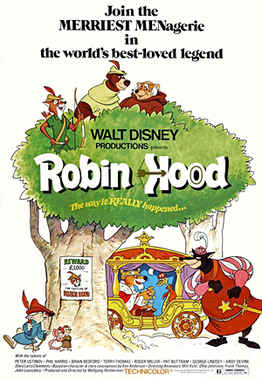
#21 Robin Hood


Robinhood 1973 poster.png
A different sort of talking-animal film than its immediate predecessors, Robin Hood avoids the problems of The Aristocats by fully anthropomorphizing its animal cast, giving us a world where the animals don't act like people, they simply are the people. The decision gives the story of Robin Hood a whimsical element, while also allowing the artists and animators to play around with a wide variety of anthropomorphic animals: the citizens of Nottingham are mainly woodland creatures, while the soldiers are imposing hippos, elephants and rhinos.

All the key players from any telling of Robin Hood's story are present. Robin Hood himself manages to be a charming protagonist, while Little John, voiced by Phil Harris, essentially comes off as a retread of Baloo from The Jungle Book, though it's not necessarily detrimental. Prince John, meanwhile, is given a comically effeminate interpretation, with Sir Hiss (basically a discount version of Kaa) practically functioning as his battered spouse; the gay subtext between the two is hard to ignore. The Sheriff of Nottingham has the potential to function as a more threatening counterpart to the foppish prince, but that potential is diluted considerably by the use of voice actor Pat Buttram, whose reedy midwest twang is decidedly non-threatening. Maid Marian is there as well, though she exists purely as a love interest to be rescued by Robin Hood, doing nothing in any of the film's (quite fun) action sequences.

Though Robin Hood is, overall, a fun children's film (and a decidedly better one than The Aristocats), it does represent a few bizarre decisions on the part of the filmmakers, most notably with the voice acting: half the characters are appropriately English or Scottish (though their accents do seem a bit affected and less-than-genuine), and the other half speak in undisguised rural American accents, a bit confusing for a film based on a notable English legend (though not without precedent, as witnessed by Arthur in The Sword in the Stone). Additionally, the songs are chiefly American country/folk (with a bit of surf guitar thrown in during the actions scenes), and the film is narrated by folk singer Roger Miller. One is left to wonder just why Disney felt the need to subtly Americanize one of England's most iconic legends; it does detract a bit from what is otherwise an enjoyable film, though not a particularly artistically groundbreaking one.