Monday, September 24, 2018
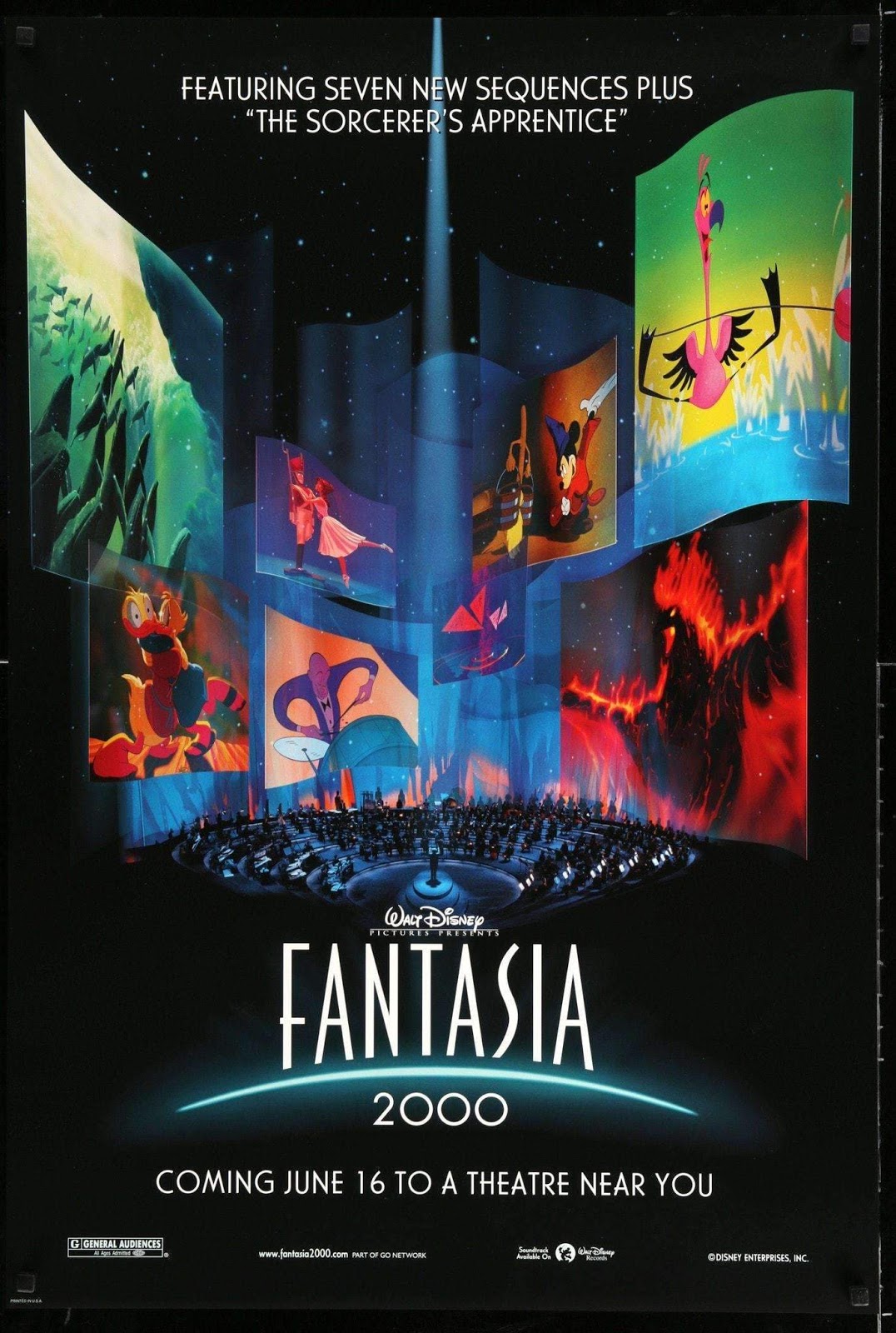
#38 Fantasia 2000
Walt Disney had always intended Fantasia to be more than just a singular film. It was supposed to be an evolving project, consistently rereleased with new segments that married music to animation. While this vision never came to fruition, the idea of creating a new Fantasia lingered on in the minds at Disney. Sixty years after the original, the follow-up materialized, and Fantasia 2000 was released at the dawn of the new millennium.
If there are criticisms to be made of Fantasia 2000, one of the first is of the framing segments. In the original, Deems Taylor provided consistent introduction and commentary for each piece; here, the segments are introduced by a revolving cast of celebrities. While Angela Lansbury and James Earl Jones fit the program just fine (both possessing a level of dignity and class befitting of the relatively highbrow tone of Fantasia), there's also turns from Steve Martin, Bette Midler, and Penn and Teller. Their presence unfortunately detracts from the enchantment and spectacle of the animated segments, breaking up the flow and tying the film a bit too much to the time of its release, depriving it of the timeless quality of the original.
The animated segments themselves are all enjoyable, the best of them clearly illustrating how far the animation medium evolved over sixty years. Respighi's "Pines of Rome" soundtracks a vision of blue whales that starts off a bit too cute (with a baby whale more than a bit reminiscent of Dumbo) but ends in a pod of whales ascending into the sky as the music reaches fever pitch, creating an incredible sense of scale and grandeur. "Rhapsody in Blue" is the clear standout, drawn in the style of illustrator Al Hirschfeld and possessing a sense of character and nonstop kinetic energy that ranks it among the very best of Disney's shorts. "The Steadfast Tin Soldier" is a straight telling of the Hans Christian Anderson tale, though without Anderson's characteristically depressing ending. "The Carnival of the Animals" gives us a flamingo with a yo-yo breaking from the routine of the other flamingos; it's amusing enough, but so brief that it scarcely has time to leave an impression. "Pomp and Circumstance" is used to tell the story of Noah's Ark, with Donald and Daisy Duck along for the ride; Elgar's dignified piece fits quite aptly with the throngs of animals marching along. Finally, "Firebird Suite" closes with some of the film's most stunning imagery and animation, presenting an enormous Firebird and a life-giving Sprite as primal forces of destruction and creation.
Though not the revolutionary experiment that Fantasia was, Fantasia 2000 nonetheless earns its place as an underappreciated entry in Disney's canon. It's a bit regrettable that it still wasn't able to turn Fantasia into the annual or semi-annual venture that Walt Disney envisioned, even if only to serve as a showcase for top-tier animated shorts, a format that has become largely ignored by the mainstream over time. As it is, Fantasia 2000 and Fantasia will always stand as a view of the most imaginative and beautiful shorts from two eras of animation history.
Monday, September 10, 2018
#37 Tarzan
After ten years and ten films that defined an era in animation history, the Disney Renaissance came to an end in 1999 with Tarzan, Disney's adaptation of Edgar Rice Burroughs' pulp icon. As with other Disney adaptations, the film redefined its subject for a new generation, giving us a Tarzan that ranks on par with the Beast as a masterstroke of character design. Bearing little resemblance to the Hollywood hunks that played the character in B-pictures dating back to 1918, this Tarzan is leaner, wilder, and more feral, possessing an air of innocence and intensity in equal measure. What truly sells Tarzan is his animation, as he runs and swings through the jungle with an animalistic elegance, moving like a man who really did learn how to walk from gorillas.
As a whole, the denizens of the jungle are moderately enjoyable without being overly memorable. Lest we forget this film was released in the nineties, we've got Rosie O'Donnell as Terk and Wayne Knight as Tantor, both of whom are used chiefly for somewhat distracting comic relief, although their friendship with Tarzan at least feels sincere. Glenn Close's performance as Tarzan's adoptive mother, Kala, provides the emotional anchor for the film; she rescues Tarzan as a baby and provides him with stability throughout his life, first as an outsider child in the gorilla family, then as an adult confronted with other humans, knowledge of the outside world, and the question of whether he belongs among ape or man. On the human side, Minnie Driver gives an interpretation of Jane that's charmingly awkward, yet progressive; she's a naturalist who comes to Africa to study the gorillas, and not simply here to function as Tarzan's jungle bride. The film's villain, Clayton, meanwhile, is a sinister take on the Great White Hunter archetype, revealing the greed and savagery below the suave exterior of a man who views the natural world as his to claim for his own.
Musically, Tarzan's songs are mostly non-diegetic (not sung by characters within the film) and handled by no less a person than Phil Collins. While Collins is no Elton John, his distinctive vocal timbre fits surprisingly well here, with all of his songs punctuating and enhancing the story and none of them feeling dated (although "Son of Man" is a bit too Collins for its own good, instrumentally at least). "Two Worlds" opens the film while laying down the central theme, "Strangers Like Me" captures the yearning and sense of wonder as Tarzan learns of the human world for the first time, and "You'll Be In My Heart," while admittedly a bit sappy out of context, earns its place in the canon of big, sweeping Disney ballads.
As the twentieth century ended and the twenty-first began, increased competition from studios such as Pixar and Dreamworks as well as changes within Disney as a company would result in an output that was diverse, risky, occasionally ambitious, and wildly inconsistent. For much of the next ten years, Disney would be heading back to the wilderness.
Thursday, August 31, 2017
#36 Mulan
Released near the tail end of the Disney Renaissance, Mulan proved to be Disney's best effort since The Lion King, marking a welcome return to form after several middling films. Retelling the Chinese folk tale of a female warrior, Mulan is at once an adventure film, a feminist parable, and a subversion of some of Disney's oldest tropes.
Dispensing with the bizarre, immersion-breaking asides and lackluster stabs at humor that plagued Hercules and The Hunchback of Notre Dame, Mulan's story is played straight, with the Hun invasion of China providing the impetus for Mulan to take her aging father's place in the army as a means of proving her value in a society that places no importance on women. Mulan herself is the antidote to decades of Disney princesses whose entire motivation was to get married to some uninteresting prince; she is not un-feminine, but finds herself unable to accept the position of the submissive daughter and eventual wife that Chinese society has allotted her. Her relationship with Li Shang is based more on mutual respect than anything else, and it is actually allowed to develop realistically - there is no hackneyed love-at-first-sight moment. Mulan's character arc, from humiliating herself in front of a matchmaker to saving her country from the Huns, is one of Disney's greatest, and the scene of the Emperor of China leading a mass of people in bowing before her is a genuinely earned payoff.
Apart from its story, one of Mulan's greatest strengths is its cast, which is a gathering of star talent in top form. Refreshingly for Hollywood, the majority of the Chinese cast are played by actual Asian actors: Ming-Na Wen as Mulan, B.D. Wong as Li Shang, George Takei as the Ancestor, and the great Pat Morita as the Emperor. Miguel Ferrer has an impressively sinister turn as Shan Yu, lending a genuine sense of danger to the savage Hun leader. Eddie Murphy's performance as Mushu comes dangerously close to Dreamworks territory at times, but his humor sticks the landing for the most part, and his genuine loyalty to Mulan makes him a better Disney sidekick than some. Even the non-speaking characters, like the Cricket and Khan the horse convey an abundance of personality and charm.
Musically, the film shines as well, with Jerry Goldsmith's bold, cinematic score lending a suitably epic feel - the standout is the synth-and-drum piece that plays as Mulan prepares to leave home for the army, which lends the proceedings a sense of high drama and importance. The songs by Matthew Wilder and David Zippel are all on point as well, all existing in the service of plot and character; there are none of the dispensable numbers that plagued some other late-period Renaissance films. "Honor To Us All" and "A Girl Worth Fighting For" lay down some welcome satire on the roles of men and women in the Chinese society the film depicts, while "I'll Make A Man Out Of You" remains one of the greatest training montage sequences in film history, Rocky be damned. And, of course, we have Mulan's character piece, "Reflection," which, over the years, has received a second life as a queer anthem.
While it may not quite reach the grand artistic achievement of The Lion King, Mulan absolutely defines itself as one of Disney's greatest films. It's a perfect marriage of character, story, music, and theme that scarcely misses a beat. The film's greatest legacy, perhaps, is the value it represents to its target audience. Mulan is no pining princess or passive love interest: she is the hero of her story, and she sets an example for every young girl that watches this film.
Sunday, August 27, 2017
#35 Hercules
Greek mythology has proved fertile ground for screenwriters and filmmakers to mine for material over the years, and with good reason: many of its most iconic characters and stories have become baked into our culture over time, so that names like Odysseus, Achilles, and Hercules need no introduction. In addition, the lack of a definitive telling of these stories leaves them wide open to interpretation. One would think, then, that with all of Greek mythology to draw upon, Disney could produce something fun and exciting, something like Clash of the Titans by way of Aladdin. Instead, we got Hercules, one of Disney's more frustrating ventures, precisely because of how much wasted potential it represents.
To start with, the plot of Hercules runs very thin. We start off with Hades (voiced by James Woods, whose fast-talking, sarcastic performance is easily the best thing about the film) learning that Hercules will one day defeat his plan to free the Titans and conquer the world. This presents us with our first problem, an unoriginal motivation for the villain. Scar wanted to seize control of the Pride Lands because he was jealous of his brother; Frollo wanted to kill Esmeralda because he was confused by a combination of racism and lust; Hades just wants to rule everything because, well, he's the villain and of course he does. The plan to kill the baby Hercules goes awry, and Hercules is raised by mortal parents. Of course, he becomes a "misfit" who "isn't like other people," which the film conveys in the most unsubtle manner possible, by having the characters straight-up tell this to the audience. Eventually, Hercules discovers his identity as the son of Zeus, who tells him that to join the Gods at Mount Olympus, he must prove himself to be a "true hero."
It's here that the real problem of the plot develops, which is that "becoming a true hero" or "proving oneself" is simply not a compelling basis for a plot, chiefly because it lacks a definitive goal or endpoint. Hercules then spends a good deal of time training with the Satyr Philoctetes (voiced by Danny DeVito, who, it should be noted, should never be allowed to sing on film again), then goes to Thebes to find a chance "to prove himself," before defeating a Hydra that, if nothing else, is an impressive piece of animation. By this point, we are nearly halfway through the film, and the audience has only just now witnessed Hercules, the legendary hero of Greek myth, actually do something heroic. Immediately afterward, the audience is treated to a montage of Hercules' adventures and heroic deeds, by the end of which he is a celebrity and an established hero. This is perhaps the film's biggest sin, that all of the adventuring that would actually allow the audience to see Hercules develop into a hero happens essentially offscreen, in an egregious violation of "show, don't tell."
And speaking of "show, don't tell," we have Hercules' relationship with Megara, surely the most chemistry-deficient pairing in all of Disney. While Meg has a potentially compelling background, as a woman who sold herself to Hades in exchange for her lover, her characterization falls flat and Susan Egan's performance comes off as grating. It doesn't help that Hercules himself isn't that likable of a character either, being given a cliched misfit characterization at first, then frequently coming off as whining. Apparently, the film also hopes the audience won't notice that Hercules and Megara are only officially together for less than 24 hours before the climax picks up and they're willing to lay down their lives for each other. Even for the studio that frequently gives us teenagers falling in undying love at first sight, this is pushing plausibility a bit too far.
The truly frustrating thing about Hercules, though, is that it definitely could have and should have been a better movie than it is. With all of Greek mythology to pull from, why produce such a bland story? Why not tell the story of Hercules' Twelve Labors, or the voyage of the Argo, which Hercules was a part of? Or, if you want to tell an original story, why not pair Hercules with Pandora, a well-known mythical figure with a compelling backstory? If nothing else, Hercules was certainly evidence that the Disney Renaissance was on the downswing by 1997 - though the streak would not be broken just yet.
Thursday, August 17, 2017
#34 The Hunchback of Notre Dame
The Hunchback of Notre Dame is anchored by the relationship between its protagonist, Quasimodo, and its antagonist, Frollo. Quasimodo is designed to be genuinely ugly without being visually repulsive, still allowing the audience to sympathize with him, and Tom Hulce's performance conveys his naivete and innocence perfectly - he is a gentle being, raised in isolation, desiring to experience life outside Notre Dame, but convinced by Frollo that the world is too cruel to accept him. Frollo, meanwhile, is truly one of the great villains of Disney's pantheon, for much the same reason that Gaston is such an effective villain: he is a villain that exists in reality, whose evil we can know from our own experience. Frollo is a religious zealot, too deeply convinced of his own sanctity to ever admit fault, obsessed with destroying the Gypsies he holds responsible for the immorality of the world around him. Most dangerous is his obsession with the Gypsy woman Esmeralda, who he blames for corrupting him by inciting his lust, to the point where he will willingly kill innocents and burn Paris to remove her temptation from his life. Tony Jay's sublime baritone grants Frollo his sinister presence and menace, nowhere more effectively than in the song "Hellfire," which ranks with Pinocchio's Coachman and Fantasia's "Night on Bald Mountain" as the darkest sequence in Disney's canon. Filled with imagery of damnation and sexual lust, "Hellfire" steps into unprecedented territory for a Disney film.
On the subject of music, The Hunchback of Notre Dame captures the grandeur and drama of a true theatrical musical more than any other film of the Disney Renaissance. Rather than being concerned with providing earworms or fun sequences, the songs largely serve as a means of character development. "Out There" establishes Frollo and Quasimodo's relationship and illustrates Quasimodo's yearning to experience life outside Notre Dame; "God Help the Outcast" draws the contrast between the desires of the ordinary people of Paris and the persecuted gypsies. Composer Alan Menken also delivers some of his most underrated work, with towering strings, horns, and choirs giving the score a grand Gothic feel, anchored by the "Hellfire" leitmotif.
For such a boldly mature film, it may come as unsurprising that the weakest aspects of Hunchback come when it tries too hard to be typically "Disney." Specifically, one can look at the three gargoyles, Victor, Hugo, and Laverne, whose presence severely taints the film. The three are painfully one-note, their personalities amounting to "old woman," "fop," and "Jason Alexander," and their musical number, "A Guy Like You," is quite frankly wretched, attempting to inject the anachronistic humor of Robin Williams' Genie into the film. But this is not Aladdin, the three are not Robin Williams, and the gargoyles' antics are totally at odds with the tone of the film.
While the presence of the gargoyles certainly drags the film down, the superior qualities of The Hunchback of Notre Dame are readily apparent. Had Disney been more willing to dispense with fluff and fully embrace the film's identity as a dark, mature story, it could have been one of the pinnacles of Disney's canon. As it is, while certainly a film of quality, it stops just short of true greatness.
Sunday, September 18, 2016
#33 Pocahontas

All good things must come to an end. After the powerhouse five-film run of The Little Mermaid, The Rescuers Down Under, Beauty and the Beast, Aladdin and The Lion King, Disney broke their hitting streak with Pocahontas, which, while not exactly a bad film, fails to live up to the heights set by its predecessors (though anything was likely to be a letdown after the triumph of The Lion King).
Artistically, the animation loses something from the lifelike fluidity of The Lion King, though that may be due to the switch from graceful animals back to a human cast. The voice acting is decent, although having Mel Gibson voice the English John Smith causes him to stick out sorely when he's the only colonist with an American accent. Musically, the film is nothing to write home about either; while some of the Native-inspired score pieces set the atmosphere well, most of the songs are forgettable, with "Colors of the Wind" being the only one most people are likely to remember, although its sequence within the film is frankly ridiculous when you step back and look at it. Indeed, the best song in the film might be the end-credits number "If I Never Knew You," which wouldn't sound out of place in an American Idol finale.
The film's real problems, however, run a bit deeper. The term "Disneyfication" has long been applied to Disney's tendency to clean up the source material its films are based on to make them appeal to a family audience and fit the traditional formula of a rapidly blossoming romance with plenty of musical numbers. In many cases, the resulting films are of enough quality that this can be forgiven or overlooked. What is harder to excuse, however, is Disneyfying actual history, especially history with as bloody of a legacy as American colonization. In the film, we're given an 18-year-old Pocahontas who falls in love with John Smith, saves his life, and brings the Natives and English to mutually respect each other. In reality, the incident in question occurred when Pocahontas was a child, if it actually happened at all. The film also tries to paint the conflict between the Natives and English as a misunderstanding fueled by prejudice on both sides, grossly oversimplifying the roots of colonialism. While the idea of peoples in conflict being brought together by a love affair could certainly be a compelling one, applying it historical events that ultimately led to the destruction of one side in favor of the other is tone-deaf at best and culturally damaging at worst. While Pocahontas is nowhere near the worst film in Disney's canon, its sins are certainly unique.
Tuesday, August 2, 2016
#32 The Lion King

Has there ever been a better opening shot of a Disney film (or of a film, period) than the red sun rising over the horizon of the African savannah with Lebo M. wailing in Zulu? It's a fantastic moment that sets the tone for the film to follow, an exercise in lush artwork, incredibly lifelike animation, and a new level of cinematics for Disney. More than just a great Disney film, more that a great animated film, The Lion King is the first entry in Disney's canon that just truly feels like a great film, period.
Rather than a fairy tale or princess-based romance, the story is more mature, almost Shakespearean in tone (there are marked similarities to be found between The Lion King and Hamlet). We have a rightful prince afraid of his past in Simba; in Scar, we have the power-hungry outcast, plotting the deaths of his family in his rise to the throne(ironic that a lion ends up being one of the most humanly evil villains of Disney's canon); in Mufasa, we have the wise, beloved father who dies the most emotionally devastating death in all of Disney - unlike in Bambi, where the protagonist had to learn what death was, Simba knows exactly what is unfolding in front of him, and he's forced to watch the whole thing. The themes of betrayal, redemption, and acceptance of the past run strong throughout the plot, which culminates in one of the most visceral fights ever seen in a Disney film; thanks to the strikingly fluid, realistic animation and the brilliant slow-motion action, the scene is elevated to the highest of drama.
Artistically, the film elevates Disney to a level never before achieved. The cinematic flourishes present in some of the free-camera shots of Beauty and the Beast and Aladdin blossom here into a true replication of live-action cinematography, with the result that the production value feels far higher than any film before it. The artistic centerpiece of the film is the wildebeest stampede, which earns its place as one of the great scenes in cinema history: everything about the scene is absolutely perfect, from the mounting tension at the beginning to the panicked action to the devastating culmination of Mufasa's death. And all of this says nothing of the film's music, with an epic score by Hans Zimmer and easily the greatest Disney soundtrack, courtesy of Alan Menken, Tim Rice, and Elton John.
The Lion King would ultimately prove to be the peak of the Disney Renaissance. While the remaining Renaissance films would carry on the cinematic values it introduced, none would fully replicate its success. In the end, there's little denying it: The Lion King is, hands down, the greatest film Disney has ever produced, and one of the pinnacles of the entire animation medium.
Sunday, July 31, 2016
#31 Aladdin

Coming off the towering artistic achievement of Beauty and the Beast, Aladdin took the Disney Renaissance into the realm of Arabian Nights, marrying lavish Middle Eastern aesthetics to a story filled with adventure, magic, romance, and a surprising amount more direct humor than most of Disney's fantasy pieces.
Aladdin is a serviceable hero, though a rather bland one: his only real motivation and struggle involves how to end up with Jasmine. Jasmine herself is a bit more compelling: she's trapped by a sheltered existence in a society that demands that she play the role of a princess and get married, when she desires a more meaningful life (and of course we get the typical love-at-first-sight Disney romance we've seen over and over by this point). Jafar manages to earn himself a place in the pantheon of Disney villains through his power-hungry plotting and sleazy demeanor (courtesy of voice actor Jonathan Freeman), while his power-escalation during the climax lends it quite an epic feel. The Sultan, on the other hand, is a completely ineffectual doddering fool, effortlessly dominated by Jafar and harping on about a marriage law that, as a monarch, he surely has the power to get rid of (which he does at the end, making one wonder why he didn't do so in the first place).
The true standout of the film though, is, of course, Robin Williams as the Genie. Prior to his entrance, the film is a straightforward Arabian adventure film revolving around a romance; once he appears, he immediately steals the entire film, firing off sight-gags, pop-culture jokes and references to other Disney films with riveting abandon. The filmmakers gave Williams free reign to ad-lib during the recording sessions, with the animators translating his signature brand of manic unrestraint to the screen. The result is a character that feels one hundred percent like a Robin Williams performance, one of the few times an animated character has been made to so perfectly embody the qualities of their performer, and possibly one of the greatest voice acting jobs of all time. If there's anything negative to be said about Williams as the Genie, it's that it opened the door for a long succession of animated films that cast A-list actors more for their name than for their suitability to the role (witness half of Dreamworks' animated output).
While not quite reaching the level of elegant artistry achieved by its immediate predecessor and successor, Aladdin still manages to be a film of quality, blending disparate elements of adventure, romance, and humor into a unified package that stands as a testament to the skill of the animators, the voice cast, and especially to the never-to-be-replicated talents of Robin Williams.
Wednesday, July 27, 2016
#30 Beauty and the Beast
Continuing Disney's early-Renaissance streak, Beauty and the Beast was the first animated film to be nominated for a Best Picture Academy Award, and for good reason; it's a marriage of artistic style, music, animation, and story that comes together with a fantastic sense of unity and cohesiveness as it redefines a classic fairy tale for the modern age.
In crafting the film's aesthetic, the animators delved straight into the original story's French origins, rendering both lush, picturesque countryside landscapes, and expansive Gothic architecture for the Beast's castle. The attention to detail and atmosphere in the castle is such that it almost becomes a character unto itself, especially in early scenes: the dimly lit, massive rooms feel at once vast and suffocating. As for the characters themselves, they're an excellently varied cast. Belle manages to stand out among the crowd of Disney princesses by being unashamed of being intelligent and wanting more out of life than her backwater town can provide. The Beast himself stands as a triumph of character design, combining aspects of various animals into a whole that isn't recognizable as any existing creature, but manages to embody the definition of the word "beast" with perfection, while Robby Benson's performance as a bitter, angry, childlike creature succeeds in adding complexity and humanity to what could be a generic animal-man character (he is not, as one commentator termed it, "Disney's Wolverine"). Gaston, meanwhile, emerges as a uniquely sinister villain: he's a supremely arrogant boor who believes that his masculinity entitles him to women's affections, and whose driving goal is to domesticate an independent woman - in short, he's the kind of misogynist we all know.
The animation sequences, meanwhile, are bolstered by a more liberal use of CGI to have masses of characters and objects moving in concert (witness the spectacularly choreographed "Be Our Guest"), as well as to add a new cinematic dimension to sequences like "Beauty and the Beast," with the camera free-flying throughout the ballroom. And on the subject of the music, it's another standout of the film, with Alan Menken and Howard Ashman crafting a set of songs that move the story forward, while still leaving space for showstoppers like "Be Our Guest" and "Beauty and the Beast." (Incidentally, the song "Human Again," cut from the original film and restored for the Special Edition, would be better left out; the lyrics are subpar by Menken and Ashman's standards, and the sequence as a whole is too similar to "Be Our Guest.")
Beauty and the Beast is, much like Sleeping Beauty, an absolutely beautiful film, but while Sleeping Beauty embodies storybook elegance, Beauty and the Beast delivers a more modern, diverse beauty, peppering in Gothic regality, timeless love story tropes, mystical intrigue, and moments of humor. If fairy tale films are the meat of Disney's canon, Beauty and the Beast represents their pinnacle.
Monday, February 8, 2016
#29 The Rescuers Down Under

Numerous Disney films have gotten sequels over the years, most of them direct-to-video and almost all of them uniformly terrible. The Rescuers Down Under is the only one to be considered official Disney canon, and also the only one to be superior to its predecessor in every conceivable way. Gone is the stiff xerographic animation and musically sterile production of the original; Down Under is so relentlessly fun, adventurous and exciting that the original seems positively glacial by comparison.
While The Little Mermaid was still a bit of a transition from the post-Walt era to the Renaissance in terms of animation, Down Under is the first true display of what made Disney so great in the nineties: fluid animation, impeccable artwork, a restrained use of CGI, and cinematography that feels genuinely cinematic. The sequences of the golden eagle, Marahute, seem to exist chiefly to display the fantastic style of Disney's new order, and they succeed admirably: these sequences on their own possess more of a grand sense of exhilaration than some entire post-Walt films. Even the characters and environments returning from the first film seem entirely fresh and new, reimagined through the lens of Disney's new artistic paradigm.
And those returning characters are better than they ever were in the original film, thanks to a fantastically fun script with an emphasis on characterization. Bernard and Bianca emerge as far more active and interesting characters (partly because Down Under actually lets them do things), while their relationship actually gets some time to establish and develop. The objective of their mission, Cody, is essentially a male version of Penny, and while he's admittedly the least interesting character, he is at least proactive, evidently spending his time releasing animals caught by poachers. The villain McLeach, played with cackling relish by George C. Scott, is a far more effective antagonist than Medusa, being both more insidious (he's a poacher who gleefully sings about murdering animals) and actually having some legitimately funny scenes - plus he drives a vehicle that looks like he stole it off the set of Fury Road. Even the supporting cast are all memorable and full of charm and personality: Jake, the charismatic mouse equivalent of Crocodile Dundee; Wilbur, the albatross voiced by the always hilarious John Candy; Frank, the neurotic frill-necked lizard; Doctor Mouse, who apparently performs surgery with a chainsaw he calls the "epidermal tissue disruptor."
While The Rescuers is fairly well-known, The Rescuers Down Under remains one of Disney's least-remembered films, possibly because it was released in the middle of Disney's greatest run of films - it's immediately preceded by The Little Mermaid, and followed by Beauty and the Beast, Aladdin, and The Lion King. While it doesn't quite reach the spectacular, visionary heights of any of those films, it's still a well-written, fun adventure film in it's own right. In short, it's everything The Rescuers should have been, but even better.
Sunday, January 31, 2016
#28 The Little Mermaid

After over 20 years of post-Walt Disney hit-or-miss films, The Little Mermaid proved to be the critical turning point for Disney's entire history. It began the Disney Renaissance, the resurgence of animation talent and artistry that continued through the nineties, redefining Disney for the modern age and reestablishing it as a true cultural institution. As a film, it established many of the tropes that would define the Renaissance, and after decades of misfires like The Aristocats and Oliver and Company, it comes off as a revelation.
Undeniably both the most ambitious and beautiful Disney film since Sleeping Beauty, The Little Mermaid establishes the elegant, lifelike style of animation that would prove a hallmark of the Renaissance. The character designs and voice acting combine in a perfect marriage to produce a fantastically memorable cast; no one feels annoying or unnecessary. The true standout is Ursula, the best Disney villain since Cruella de Vil, who conveys a fantastic diva-esque menace before blossoming into grand scale, godlike evil for a climax that feels genuinely epic. The story, while still running with the Disney standbys of love at first sight, mutual love within a few days and getting married as a teenager, manages to still be compelling enough that its flaws can easily be ignored, and it carries a genuine sense of stakes and urgency, while having some fantastic moments of emotion.
And on the subject of emotion, it's helped along by one of the best soundtracks in Disney's canon (courtesy of the first collaboration between the powerhouse team of Alan Menkin and Howard Ashman, whose work would go on to define the Renaissance, and, for many people, Disney in general). Every song hits the mark; "Under the Sea" is irresistibly fun, "Poor Unfortunate Souls" is one of Disney's greatest villain songs, and "Part of Your World" is the establishing moment for both Ariel as a character and Menkin and Ashman as a team (and also just might be my favorite Disney song).
By the time it reaches its happy ending, The Little Mermaid feels like a massive payoff. It's the first film in decades to fully recapture the majesty, artistry, fun and excitement of Disney's best efforts; above all, it's a beautiful film. If a Renaissance is a rebirth, The Little Mermaid is just that, paving the way for quite possibly the greatest era of Disney's history.
Friday, January 29, 2016
#27 Oliver and Company

The biggest problem with the film is that it's painfully dated, due in large part to the soundtrack, laden with saxophones and synth-piano that embody the corniest aspects of 80's pop (the fact that Huey Lewis sings the opening song does not help matters), in addition to being generally substandard lyrically (half of them being preoccupied with exalting New York and the "rhythm of the streets" or some such faff). The animation as well is completely lacking the timeless quality of Disney's better films, feeling more like a lesser Don Bluth effort than some of Don Bluth's own films (it might be telling that The Land Before Time opened against Oliver and Company at the box office, and roundly defeated it in its opening weekend).
The characters don't fare much better either; Billy Joel's take on Dodger is thoroughly irritating, both for the blandness of the character and Joel's insufferable affected New York accent. Cheech Marin plays Tito the chihuahua basically as himself as a dog, while Bette Midler's Georgette, while capturing Midler's diva persona well, could probably be dispensed with completely without really affecting the plot. Jenny, the utterly generic rich girl with absent parents, is functionally an export of Penny from The Rescuers, although with far less personality and some odd animation problems; her head frequently appears too big for her body, and her facial features seem to drift at points. The villain, Sykes, meanwhile, almost seems like he belongs in a far darker film, at various points discussing the proper way to perform a hit over the phone and threatening a young girl with his vicious dogs, before getting killed by a train. As for Oliver himself, he's a protagonist entirely without agency, ping-ponging between situations through factors entirely apart from his control, existing only to be irksomely precious on a borderline-Aristocats level.
Oliver and Company is a film in which very little works, coming at the tail end of a long period of Disney's history in which many things were tried, with some successes and many misfires. A new era was about to begin, however, which would restore Disney to its Silver Age greatness, and, in many ways, exceed it. The Disney Renaissance was about to begin.
Monday, January 18, 2016
#26 The Great Mouse Detective

The best aspect of the film is doubtless the hero/villain pairing of Basil of Baker Street and Professor Ratigan, whose rivalry captures the classic nemesis relationship in a manner unique in Disney's canon. Basil, voiced by Barrie Ingham and based on the archetype of Sherlock Holmes, is delightfully eccentric, swinging between barely contained mania and suave intelligence. His Moriarty, Professor Ratigan, is voiced by Vincent Price, clearly enjoying himself greatly in a flamboyant performance that makes his interactions with Basil almost homoerotic. The flamboyance of Price's performance makes the climax, with Ratigan devolving into violent, animalistic fury, just that much more effective.
The film is also an artistic triumph for Disney's animators. The exploration and chase sequences in a toy shop (artistically reminiscent of Geppetto's workshop in Pinocchio) showcase a creative energy sorely lacking in the post-Walt era. The character designs are all charming and original, while the animation quality approaches that of the Disney Renaissance (though it's a bit hard to find justification for a barroom cabaret sequence that gets almost inappropriately risque). One of the most notable elements, however, is the sequence inside of Big Ben, which employed early CGI to generate a three-dimensional environment of massive moving gears to spectacular effect. More accessible than The Black Cauldron, more energetic than The Rescuers, and possessing a creative spirit not seen in a Disney film for years beforehand, The Great Mouse Detective earns its place as one of Disney's most fun adventures.
Saturday, January 16, 2016
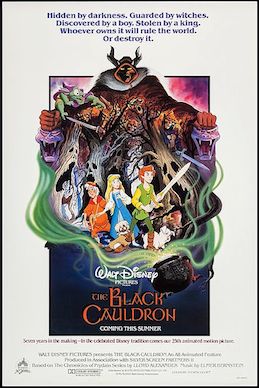
#25 The Black Cauldron

It's actually quite easy, while watching The Black Cauldron, Disney's adaptation of Lloyd Alexander's The Chronicles of Prydain, to forget that it's a Disney film at all. Thematically and visually, it has more in common with Ralph Bakshi's animated fantasy films (though still considerably lighter) than with any of the rest of Disney's canon. Perhaps because of its uniqueness as Disney's only foray into high-fantasy, coupled with its extremely dark content, the film has always been a black sheep for Disney, while at the same time being a beloved cult hit.
The Black Cauldron is quite definitely a fantasy film first, a Disney film second. The environments and character design all reflect the influence of the Celtic fantasy style Alexander originally drew inspiration from. The story and characters all embody a fairly standard set of fantasy tropes: we have the ancient, evil artifact that bestows horrifying power (the cauldron), the teenage boy who wants to be a hero, the princess (Eilonwy, who swings between being proactive and a distressed damsel as if the writers couldn't exactly decide where they wanted to take her character), the odd creature sidekick (Gurgi, whose character basically amounts to "hairy Smeagol"), and the evil lord, the Horned King (voiced by John Hurt, who rarely, if ever, gives a bad performance, this being no exception). Oh, and a pig that sees psychic visions. No, it doesn't particularly make sense in context either.
Yet, despite its adherence to formula, The Black Cauldron can actually be quite enjoyable when viewed on its own terms (even if its appeal is decidedly cult). Seeing Disney take on a high-fantasy epic is definitely interesting, and while the animation is uneven and frequently less-than-spectacular, the film makes up for it with bold, cinematic angles and camera movement. While too dark to appeal to the family audience of most Disney films, it definitely shows that Disney can accomplish quite a bit with more mature, genre-oriented material. The Black Cauldron is definitely a hidden gem in Disney's canon, and one with definite potential to be revisited in live-action; in the hands of a director like Guillermo del Toro, it could be magic waiting to happen.
Thursday, January 14, 2016
On David Bowie, Alan Rickman, and the Immortality of Artists
On Monday, January 11, the word went out that David Bowie had passed away from cancer at the age of 69. On Thursday, January 14, it was revealed that Alan Rickman had suffered the same fate. Within hours of their deaths, the news and social media were filled with conversation about these men. Statements were made by their family and friends commemorating them, while thousands of people who never knew them personally expressed sadness at their passing. By now, it's almost become a familiar script, one we've all seen before with the passings of people like Christopher Lee, and Leonard Nimoy, and Robin Williams.
It's not every time a famous person dies that they are commemorated in this way, with a near-universal expression of regret, respect, and memory. The ones that do almost always seem to have one thing in common: in some respect, they are all artists. These are not shallow celebrities of the kind American pop culture gets roundly criticized for elevating and glorifying, but people of talent, people who garnered the respect of their peers and the admiration of their audience, who had influence on their fields. People who, to the ones they inspired, genuinely mattered.
And maybe that's why people mourn the passing of Bowie and Rickman so openly. They never knew us, but we knew them. Such is the relationship between artist and audience: in putting their art out into the world, the artist becomes part of the lives of people that they will never meet. In listening to a David Bowie album or watching an Alan Rickman film, we absorbed pieces of them into ourselves, and, over time, the pieces of artists we absorb become pieces of us. Through their art, we can be influenced just as much by people we have never met as by people we have known intimately our whole lives. Would I be who I am without absorbing the influence of Philip Pullman, or Peter Jackson, or U2? No.
And in this, the beauty in the tragedy can be found, that even after the human life of an artist ends, their work and influence survives, and takes new life. In the theatricality of David Bowie, Marilyn Manson and Lady Gaga took inspiration, interpreting his influence in radically different directions that will inspire yet more artists. In Alan Rickman's performances, actors will continue to find elements that they will incorporate into their own work. And the cycle of inspiration and creation will continue, as every artist leaves in their wake a world of influence and inspiration to be inherited by new artists, to take on new forms. In this sense, every artist is an immortal.
Tuesday, January 12, 2016
#24 The Fox and the Hound

The opening credit sequence of sinister music and barking dogs playing over dark, shadowed shots of the forest gives indication of what is to come in one of Disney's darker films. As the studio's harshest look at the relationship between man and animal (and animal and animal) since Bambi, The Fox and the Hound recaptured some of the Disney quality missing from the films following Walt Disney's death. In addition, the xerographic style of animation was dispensed with for the first time since 101 Dalmatians, giving the film a cleaner aesthetic than some of its predecessors, with visuals that are good across the board, and, in the case of the massive, fearsome bear that appears in the climax, exceptionally striking.
The story of The Fox and the Hound can be read both as a metaphor for prejudice and as a subversion of the typical animal-themed children's film. Copper and Tod meet as children, unaware of the roles that man and nature intend for them to play, as hunter and hunted. Over time, they learn that they are by and large expected to be enemies. Copper eventually comes to hold Tod responsible for the near-death of his mentor, Chief (Disney pulls the punch of actually killing him), and swears revenge against him. Eventually, they meet as enemies, but end up saving one another's life. Thus, they end reconciled, but friends no longer; their relationship cannot survive.
As a story about prejudice, the film provides a commentary on societal roles in a way that is easy enough for children to understand. Copper and Tod initially have no knowledge or understanding of the roles expected of them, and they become friends in their innocence; there is no natural enmity between them. It is only the pressures of the roles placed on them that drives them apart, just as society tells us how to behave and how to think about others. On another level, the film takes the idea of the children's film about happy animals living in harmony and gives it an injection of grim reality: in a world run by man, there will be no happy ending for a fox and a hound.
And there is no typically happy Disney ending. Though everyone survives, Tod and Copper can never be together again. It's uncharacteristically bittersweet for a studio that is often perceived as being quintessentially child-friendly. Though the film's morality isn't purely gray (Amos Slade is intended as the villain, and holds far too personal a vendetta against a fox to be realistic), The Fox and the Hound goes in some bold directions, emerging as one of Disney's most poignant stories.
Sunday, January 10, 2016
#23 The Rescuers
With a story about two mice embarking on a mission to rescue a girl from an insane woman in a swamped river boat in the bayou, the film feels like it should be a lot more exciting than it is, and while there's certainly some fun to be had in it, it definitely feels lacking. Interestingly, one of the biggest hindrances to the film is its sound design and music, which feel oddly underproduced. Especially considering that many earlier Disney films have a nearly nonstop soundtrack, the total lack of background music in many scenes is jarring; it's not often one encounters total silence in a film, let alone a childrens' film, which usually feel compelled to have at least something going on to maintain the audience's attention. This lack of music drags down several scenes that should be tense and dramatic, resulting in an almost hollow feel to the production. The songs, "Tomorrow Is Another Day" and "Someone's Waiting For You," meanwhile, feel like 70's soft-rock tracks foisted onto the film (especially since they're not sung by anyone in the film, simply playing over the action).
Sound problems aside, the film also suffers to a degree from occasional animation problems (reminiscent of those present in The Sword in the Stone at points). While the voice acting is alright for the most part, it's not spectacular either; the same can be said of the background work. While The Rescuers is definitely not a bad film (a sequence of Bernard and Bianca attempting to escape from Medusa's crocodiles in a pipe organ is exactly the kind of inspired fun the film could use more of), it's definitely not one of Disney's best either.
Friday, January 8, 2016
#22 The Many Adventures of Winnie the Pooh

The practice of fusing together a series of shorts may have proved a mixed bag for Disney in the past, but fortunately, The Many Adventures of Winnie the Pooh, composed of three previously released Winnie the Pooh shorts made between 1966 and 1974, is of a higher standard than most of the package film era. The three segments are fairly seamlessly welded together, although they are still distinctly separate pieces, giving the film an episodic feel overall.
Winnie the Pooh as a film (and as a property overall) sells itself on cuteness; however, it's a far more appealing cuteness than the irritating preciousness of The Aristocats. While a film with no real antagonists and little in the way of an overarching plot has the potential to go terribly wrong, Winnie the Pooh embraces these aspects in a manner surprisingly reminiscent of a Miyazaki film. The film is ultimately driven by the characters and their distinct personalities, none of which ever feel one-note or stale. There's an undercurrent of childlike innocence and optimism running through the film that infuses it with an appeal that elevates it above mere kid-film fodder and makes it impossible to really dislike.
The most surprisingly nuanced moment comes at the end, in a sequence newly created for the film. Christopher Robin, the child who everyone in the Hundred Acre Wood turns to for advice, is going away to school, and Pooh promises that, even though they won't be together all the time anymore, he and Christopher Robin will always be friends, and he will always be waiting for Christopher Robin when he does return. It's a strikingly poignant moment, underscoring the themes of friendship that permeate the film, and almost serves to reframe the story in a more metaphorical sense: the Hundred Acre Wood is an idyllic place, free from outside conflict, where, despite being different, everyone is ultimately friends. In essence, it's a place built on the best, purest aspects of childhood, and, although Christopher Robin is growing up and will not live there anymore, it can still be returned to once in a while, much as adults can sometimes recapture the feelings of childhood. This ending scene perfectly encapsulates all the qualities that The Many Adventures of Winnie the Pooh embodies in a way that no other Disney film really does, earning it a unique place of pride in Disney's canon.
Monday, December 28, 2015
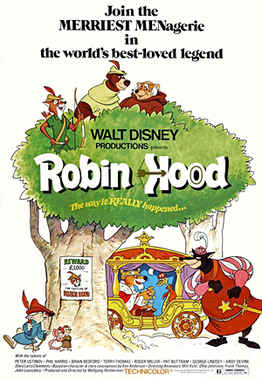
#21 Robin Hood

All the key players from any telling of Robin Hood's story are present. Robin Hood himself manages to be a charming protagonist, while Little John, voiced by Phil Harris, essentially comes off as a retread of Baloo from The Jungle Book, though it's not necessarily detrimental. Prince John, meanwhile, is given a comically effeminate interpretation, with Sir Hiss (basically a discount version of Kaa) practically functioning as his battered spouse; the gay subtext between the two is hard to ignore. The Sheriff of Nottingham has the potential to function as a more threatening counterpart to the foppish prince, but that potential is diluted considerably by the use of voice actor Pat Buttram, whose reedy midwest twang is decidedly non-threatening. Maid Marian is there as well, though she exists purely as a love interest to be rescued by Robin Hood, doing nothing in any of the film's (quite fun) action sequences.
Though Robin Hood is, overall, a fun children's film (and a decidedly better one than The Aristocats), it does represent a few bizarre decisions on the part of the filmmakers, most notably with the voice acting: half the characters are appropriately English or Scottish (though their accents do seem a bit affected and less-than-genuine), and the other half speak in undisguised rural American accents, a bit confusing for a film based on a notable English legend (though not without precedent, as witnessed by Arthur in The Sword in the Stone). Additionally, the songs are chiefly American country/folk (with a bit of surf guitar thrown in during the actions scenes), and the film is narrated by folk singer Roger Miller. One is left to wonder just why Disney felt the need to subtly Americanize one of England's most iconic legends; it does detract a bit from what is otherwise an enjoyable film, though not a particularly artistically groundbreaking one.
Wednesday, December 16, 2015
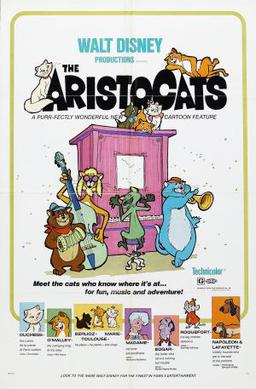
#20 The Aristocats

Speaking of the Madame, can we all agree that people who leave material inheritance to their animals are uniformly terrible? And yet the audience is supposed to be completely on board with the Madame's decision, leaving her butler, Edgar, as the villain for wanting to gain her inheritance before the cats. Sure, it's probably greedy of him, but can you blame a long-suffering servant who is apparently viewed as less-deserving to his employer than her animals? It's yet another example of the Lady and the Tramp problem of vilifying humans for not putting animals on the same social level as humans, a conceit which instantly falls apart upon consideration for obvious reasons.
As for the titular Aristocats, they're all irritatingly precious on every level, being the animal equivalent of the sheltered upper class. Thomas O'Malley, voiced by Phil Harris, is at least a bit more appealing as a character, but not by much. There's also a pair of rich-English-twit geese and their sloppily drunken uncle, a gang of swinging cat musicians (who inject some desperately needed energy into the dull and badly-paced plot with the number "Everybody Wants To Be A Cat"), and two dogs who, despite living in France, have Southern accents for some reason, and who apparently attack passing motorists with zero actual motivation. Meanwhile, the quality of the animation takes a step backward from The Jungle Book, with the Madam especially being a pencil-line ridden mess.
Yes, The Aristocats is cute, but that's really all it is. It has very little substance or enjoyment to be found for any audience but small children, and only succeeds in being saccharine. As an entry in Disney's canon, it's a decidedly weak one.
Subscribe to:
Posts (Atom)